ux research product design team · design jam
date-a-log
a 10-hour design sprint to help young adults understand their own dating lives.
the question
how can technology help young adults navigate adulthood?
the deliverable
an interactive prototype (figma, code, paper, or anything in between) built over 10 hours. our team chose figma. with a open-ended prompt and a ticking clock, the first real design decision was deciding what corner of "adulthood" was actually worth solving for.
what i did
date-a-log was a team project — jillian andrea juat, yusra amir, and myself. as a group we conducted user research, synthesized survey data, built personas, and presented our findings. individually, i was responsible for the wireframes, all hand-drawn artwork and illustration, and a portion of the figma prototype screens.
the design jam assigned a visual theme: chikitawa, a kawaii-inspired aesthetic. the hand-drawn, black-and-white illustrative style was a direct response to that constraint, not a freestanding choice. working within a forced visual language while still producing something cohesive under time pressure was one of the more interesting design challenges of the sprint.
what we found
90% of our 22 survey participants said they were currently interested in a committed relationship. qualitative responses were pointed: existing dating apps felt shallow, gamified, and full of bad actors. the dominant sentiment was that current tools optimize for meeting people, not for understanding the relationships you're already in.
"these days it's like a game, no one really takes dating apps that seriously."
this told us the opportunity wasn't another matching app. it was something that comes after the match. a tool for reflection, not discovery.
52% of participants rated understanding their own preferences as highly important. 57% said they had strong preferences or boundaries but remained open to adapting them. this suggested that users aren't looking for someone to tell them what to do. they want a mirror, not a guide. the design needed to surface patterns and let users draw their own conclusions.
a majority of participants were open to both receiving and sharing relationship advice with others. generic advice felt useless, but advice from people in similar situations felt valuable. this pointed toward community features that are filtered by situation rather than open-ended forums, and informed the forums feature in our prototype.
our solution
we landed on dating and relationships. not because it was the easiest angle, but because our research pointed there clearly: young adults weren't struggling to meet people, they were struggling to understand the relationships they were already in. date-a-log is a relationship logger: a mobile app where users track their dates, log their moods, and over time build a picture of their own patterns. it starts where dating apps leave off.
core features
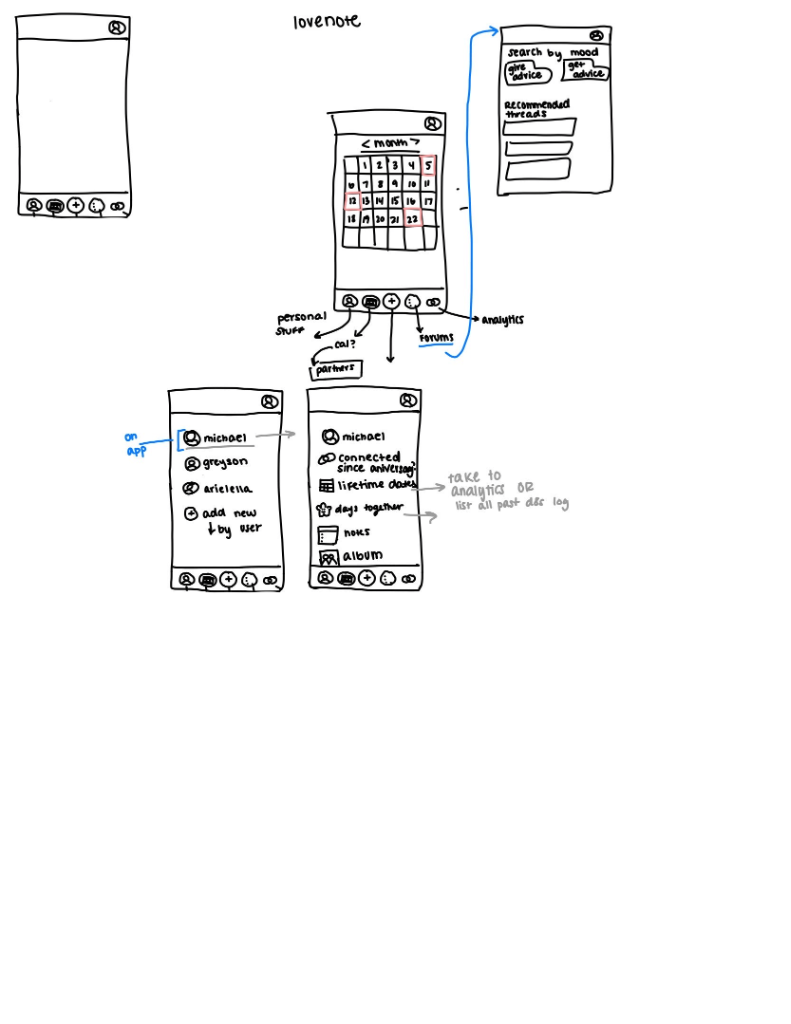
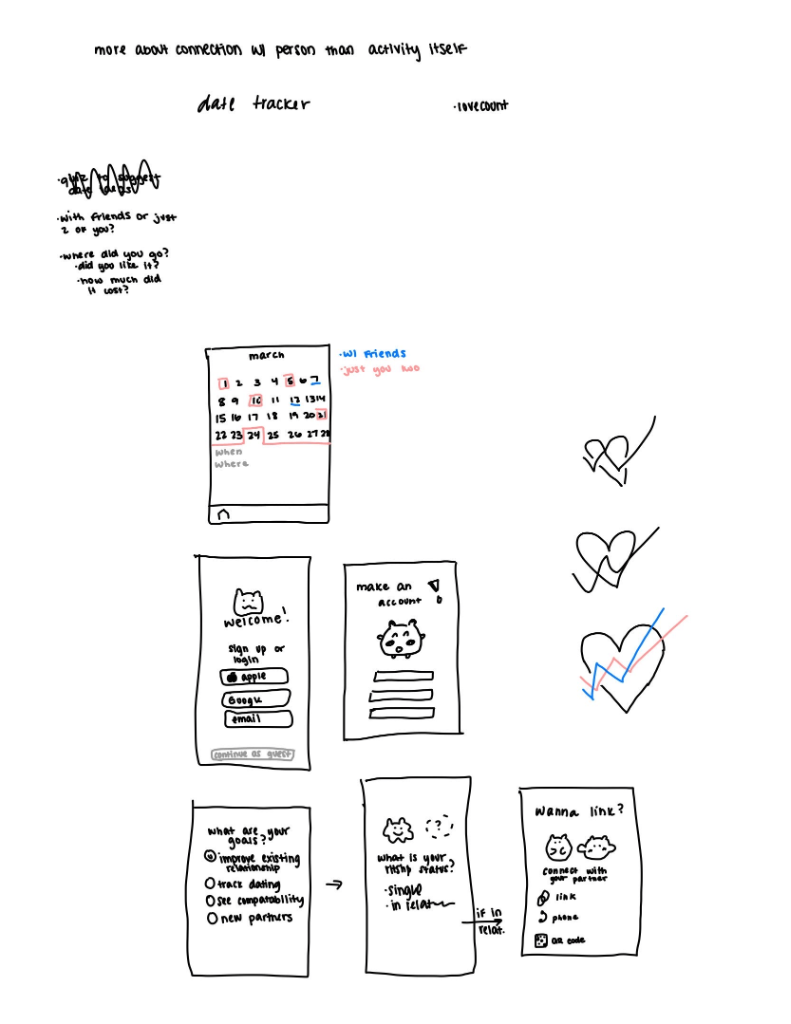
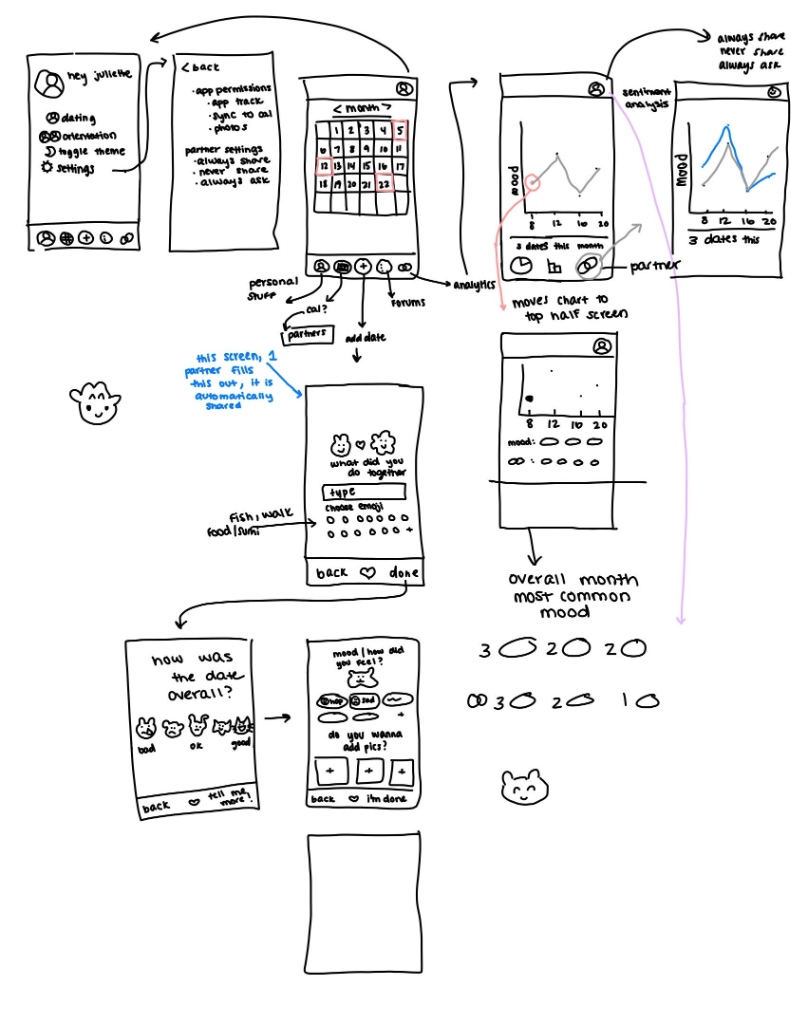
the calendar is the app's home base. users create date entries directly on it, logging what they did, where they went, and who they were with. keeping it calendar-based was a deliberate choice, grounding the experience in time, which makes patterns visible in a way a simple list doesn't. seeing three dates in one week versus none in a month tells a story without any analytics at all.
after each date, users get a short mood and reflection prompt: how did you feel, how was the overall experience, anything you want to remember. the prompts are intentionally lightweight. the goal wasn't journaling, it was capturing just enough emotional context that the data becomes meaningful over time. one-word mood ratings alone lose nuance; long journal entries create friction. the prompt format sits in between. users have the option to share all, some, or no information with their partner, and have the choice to go more in depth with journaling.
users in a relationship can link accounts with their partner, allowing both people to log the same dates and compare their emotional responses side by side. this feature came directly from our research finding that users wanted to understand their partner's experience, not just their own. it also adds a layer of accountability where both people are actively participating in tracking the relationship, not just one.
users can upload photos from their dates, which the app compiles into a personalized visual history of their relationship over time. beyond the sentimental value, the photo album serves as a memory anchor. pairing images with mood and reflection data makes the analytics feel personal rather than clinical. a graph of your emotional trends hits differently when you can also see the photos from the dates those data points represent.
the forums section lets users give and receive advice from others in similar situations. rather than a generic open forum, the design intent was filtering by situation type so that advice feels relevant rather than noise. this came from a specific research insight: participants wanted community input, but only from people who understood their context. a stranger's advice about a long-distance relationship means something different than advice from someone in one. additionally, we included the ability for users to either post anonymously, or with their account visible.
the analytics dashboard visualizes a user's relationship patterns over time: how often they're going on dates, where they're going, emotional trends after different types of activities, and how their mood has shifted across the course of the relationship. this is where the logging pays off. the goal was to surface insights the user couldn't easily see themselves, not to judge the data, but to reflect it back in a way that prompts self-awareness.
my contributions
what i learned
this was my first design jam and i didn't know what to expect. what surprised me most was how much of the work was decision-making under uncertainty, not knowing if the direction was right, but committing to it anyway because the clock doesn't wait. that muscle, making a call and moving, felt different from any classroom project i'd done before.
working in a team of three on a 10-hour deadline also clarified something about collaboration: you have to trust people fast. there's no time to over-discuss or second-guess a teammate's direction. we divided, executed, and checked in. it worked well enough to finish in the top 3 out of eight teams, which felt like a real result for a first attempt.
the chikitawa constraint was frustrating at first and interesting in retrospect. designing within a visual language you didn't choose forces a kind of creative problem-solving that open briefs don't-- you can't fall back on your default aesthetic, you have to adapt. that's a useful skill for client work, and i want to keep practicing it.